
Nail Anatomy & Health
A brief overview to understand anatomy and prevent risks while using nail enhancements
-
Nail enhancements are a temporary or semi-permanent way to bring some art into our daily lives.
The term “Nail Enhancements” is a broad term for any product or material that is intended to add length or strength to the natural nail, often also providing aesthetic benefits.
XXL poke-your-eyes-out acrylics and one coat of a clear nail polish are both considered nail enhancements!
-
With proper education and use, nail enhancements are safe to wear. As with most cosmetics, there are possible risks involved, so staying educated on our anatomy and possible risks is important!
Some common adverse effects of nail enhancements include, but are not limited to:
Thin/brittle/sore nails
Painful/bleeding cuticles
Nail separation (onycholysis)
Greenies (pseudomonas)
Allergy (contact dermatitis)
stay informed
☆☆
stay informed ☆☆
Nail Anatomy & Terms To Know
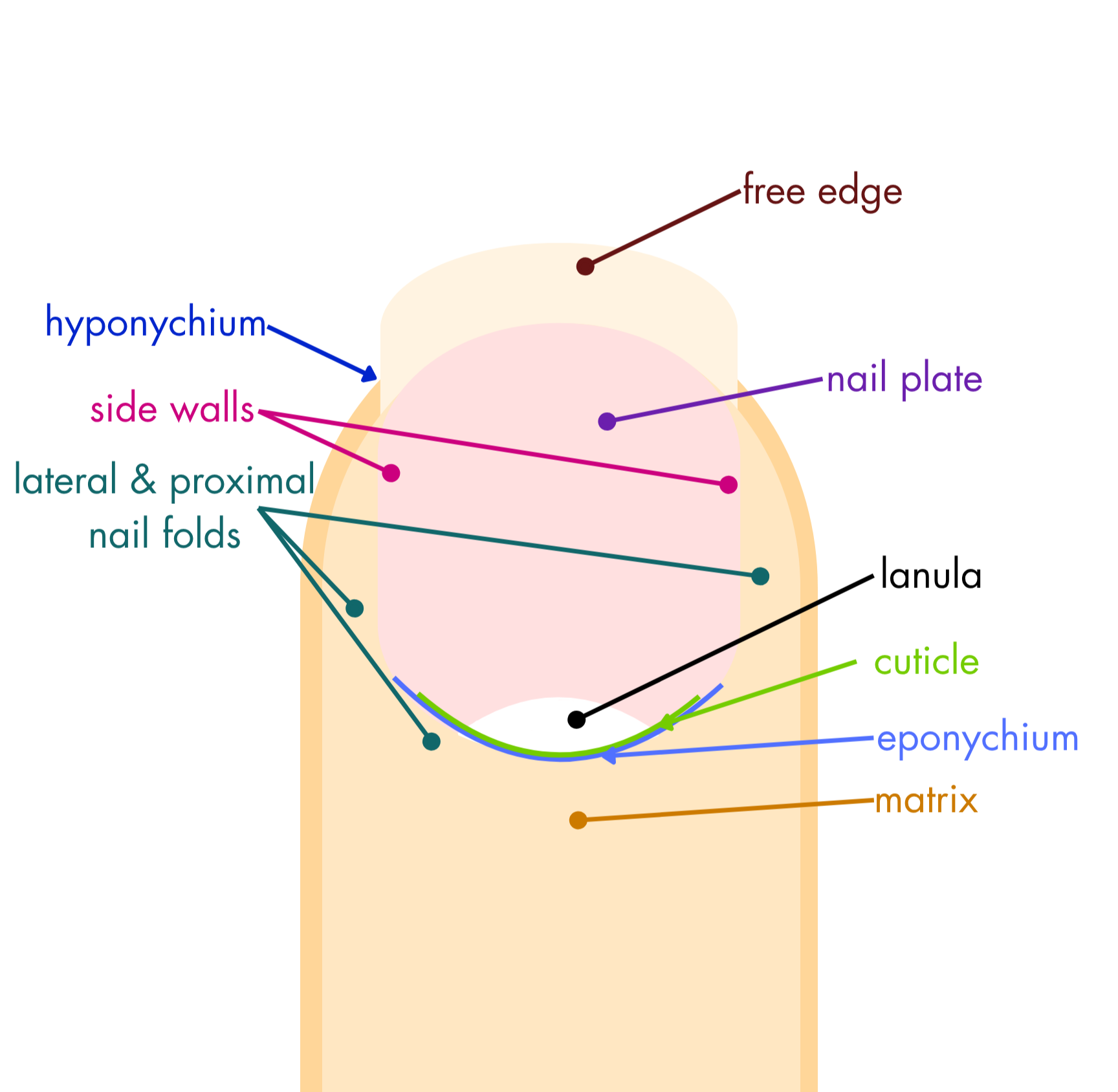
Above is an image labelling the nail anatomy
Nail Matrix: the growth source, or ‘root’ of the nail. it produces the keratin cells that create the nail plate
Lateral/Proximal Nail Folds: the living tissue that surrounds the nail, covers and protects the matrix and eponychium
Eponychium: commonly mistaken as the cuticle, it is actually living tissue and protects the body from pathogens. it is located at the base of the nail, and produces the non-living cuticle tissue.
Cuticle: ‘dead skin’ produced by the eponychium; it may be difficult to know the difference between the cuticle and eponychium at first. remember: the eponychium is living tissue and therefore will be painful and may bleed if punctured/cut/otherwise injured. the cuticle is non-living tissue and will be painless to manipulate/remove.
Lanula: the pale/white half-moon shape at the base of the nail, this shape and colour is due to the cells not being fully keratinized (or hardened) yet. some people may not have a visible lanula on every finger or at all
Nail Plate: referred to as just “the nail” or “natural nail”. It is made of many layers of hardened keratin, which are not living tissue. connects to the nail bed and hyponychium
Nail Bed (not labelled): the soft tissue under the nail plate. the blood vessels in the nail bed give the nail plate its paler or pink-ish hue
Free Edge: the part of the nail plate that extends beyond the nail bed
Hyponychium: living tissue that attaches under the free edge and seals the fingertip to the nail; an extension of the nail bed. take care not to puncture the hyponychium with aggressive cleaning, clipping, or filing the free edge
Side Walls: the left & right sides of the nail plate & free edge that connect the edge of the nail plate to the lateral/proximal nail folds. the side walls are imperative for proper nail structure when creating and maintaining both natural and artificial nail length. Removing or filing the side walls is an unsafe technique used to create the appearance of a narrower nail. Removing the side walls negatively impacts the structure of the nail, increasing the chances of breakage and hangnails. Filing the side walls of the nail plate that is attached to the nail bed to achieve a narrower nail bed appearance can cause pain, micro-tears, cuts/bleeding, increase chances of infection, and lead to onycholysis (nail separation)
stay informed
☆☆
stay informed ☆☆
Thin, Brittle, and Sore Nails
Nail strength/thickness is affected by a multitude of factors. Our genetics, environment, diet, and other health conditions can determine how our nails grow.
Nail enhancements can add strength and length to the natural nail, but improper care can have the opposite effect and leave our nails flimsy and breakable.
Nails that have been over-filed can often lead to thin nail beds prone to breakage with painful patches; this is often referred to as “rings of fire” due to the thin patches often exposing more of the sensitive nail bed that the nail plate is meant to protect.
How can we prevent rings of fire? It may take practice, but understanding the difference between properly prepped nails and over-filed nails is the key. Prepping the nail plate should never feel painful, so if you experience any amount of pain or burning sensations, stop filing and evaluate the nail plate for damage. Note that over-filing and rings of fire are most commonly caused by improper use of an electric file/drill (e-file). Anyone using an e-file should use caution and seek out education on proper use.
Another cause of thin and brittle nails is when we pick at and tear off our nail enhancements. Our nail plates are made of 25-100 super thin layers of keratin, these layers will start peeling apart when we rip, tear, or bite off the nail enhancements. To prevent this peeling, always exercise proper removal of all nail enhancements. Removal methods vary depending on the type of enhancement that is used, for press on nails there are at-home soak-off methods or glue removal products available on the market. See my page on How To Remove for instructions on the soak-off method.
So, you have some rings of fire or peeling and now your nails are thin and breaking? Not to worry, this is temporary! Keep your natural nails short to avoid breakage along the free edge, which can crack down into the nail plate, and simply wait for the damaged nail to grow out.
Painful and Bleeding Cuticles
Nail prep often includes “cuticle work” where we detach, push, and sometimes cut the dead tissue called the cuticle. Having excess cuticle and dead skin on the nail will prevent the nail enhancement from properly adhering to the nail plate and can cause premature lifting or potentially trap moisture between the natural nail and the artificial nail; more information later.
When partaking in any cuticle work, we must start with clean hands and tools. Never share your nail tools (clippers, files/buffers, cuticle tools, etc), and always ensure that tools are single-use or properly disinfected/sanitized when going to a salon/independent tech.
Everyone has a different skin type and sensitivities, but cuticle work should never be painful. You may experience a tiny pinch due to the dead skin putting a small amount of pressure on the living tissue as it is pushed back, but this should not be prolonged or intense. If your cuticle work is uncomfortable, you may be applying too much pressure, or the skin may be extra tough, dry, or sticky. Soaking the fingertips in warm water, massaging with oil, or using products intended for cuticle removal can all aid in softening the cuticles for nail prep.
Its important to know that cutting the cuticles is a high risk action as it can be easy to accidentally cut the living tissue that surrounds the nail (proximal/lateral nail folds or eponychium). In some locations, it is actually illegal to cut the cuticles due to this increased risk of creating open wounds, which in turn increases the risk of infection and bloodborne disease transmission. I do not recommend cutting the cuticles unless properly trained to do so in locations where it is permitted.
In general, overworked cuticles are just inflamed and irritated and will calm down pretty quickly.
Nail Separation (onycholysis)
Onycholysis is generally painless and is when the nail plate begins to separate from the nail bed, usually starting at the free edge and separating down the nail towards the cuticle.
Onycholysis is most commonly caused by extreme or repeated trauma to the nail. Tearing, ripping, or biting the nail enhancements or natural nails can cause separation, as well as aggressive cleaning under the free edge with tools. Uniquely, with press on nails, an improper fit may also risk onycholysis. If the press on nail is too small, the constant tight, squeezing pressure can be prolonged trauma and begin to cause separation. This is why it is important to size the press on nails accurately, for more information on sizing, see my How To Size guide.
Fungal infections, allergies, or other health conditions may cause onycholysis, however there will often be other symptoms beyond just nail separation. If you have any concerns, please seek professional medical care.
If you are experiencing minor nail separation, keeping the nails short and avoiding nail enhancements are recommended. Allow the detached portion of the nail to fully grow out before resuming use of enhancements.
Greenies (pseudomonas)
Pseudomonas aeruginosa, or more commonly called Greenies, is an infection that appears as green discolouration of the nail plate. Greenies can also occur alongside onycholysis or other nail infections.
Pseudomonas is a bacteria that is found in water sources, and on humans and animals and thrives in moist conditions. Unclean tools at salons/independent techs can also be a risk factor in greenie transmission. Ensure that when applying any nail enhancements, the natural nail is clean of debris (dust, oil, dead skin, etc) and fully dehydrated before applying any products. Avoid air-pockets or incomplete adhesion as this can also begin to trap moisture between the natural and artificial nail as they are worn.
When your nail enhancement begins to lift, as they will with time and wear, do not apply new glue to the lifted portion and stick it back down; this is considered incomplete adhesion. You may, however, properly remove and reapply the nail if desired. For more information on application or removal, see my How To Apply and How To Remove pages
If you have any concerns of infection, seek professional medical care.
Allergy (contact dermatitis)
Allergic reactions can be caused by a multitude of sources, nail enhancement products being one of them. Allergies to nail products is commonly referred to as Contact Dermatitis, however this term is not limited to nail product allergies exclusively. Cosmetics (even fragrances), materials such as nickel (low-quality jewelry is a common cause!), and even plants (like poison ivy) can all cause contact dermatitis. Contact dermatitis is just the term for a rash or skin irritation caused by a substance or allergy (did you know that drool can cause contact dermatitis?).
When using nail enhancements, you are unavoidably introducing substances to your body, in fact its kind of the point. That being said, there are ways to reduce the risk of developing contact dermatitis to nail products (which can affect other areas of your life, such as receiving dental work). Always avoid skin contact with nail products and limit how frequently new nail enhancements are being applied; including air-dry glue or air-dry polishes/lacquer. If skin contact occurs (commonly called flooding), remove and dispose of the bulk of the product with a dry cotton swab/paper towel/etc, then use a small amount of acetone on a new cotton swab/paper towel/etc to swipe away the remaining product (even if it looks clean there will be a residue).
Press on nails do use gel and acrylic products, which when uncured pose a high risk of developing allergies. Uncured product can happen with low-quality products, low-quality or incompatible lamps, overly thick application, or the light not properly reaching the product. It is very important to only use air-dry nail glue for any type of press on nail. Press on nails are pre-painted, and therefore are opaque and will block the UV light from properly penetrating below the press on nail. Any level of pigment on a press on will block the UV rays (yes, that includes sheer and jelly products). Do not use “UV glue” for any press on nail kit, even if it was marketed as compatible with press on nails (scam alert!).
If you are experiencing swelling, itching, peeling, blistering, etc, remove nail enhancements and seek professional medical care.
With a nail product allergy, you may be unable to wear nail enhancements all together, however some people are able to find specific products that do not cause reactions. Its important to find a salon/independent tech that is educated on their products and is able to work with you with compassion to discover a system that works for your body.
